






Renewable energy sources: how they work and what they deliver: Part 4: Solar thermal hot water systems DG 532 4
BRE (Building Research Establishment) is an independent, research-based consultancy, testing and training organisation, operating in the built environment and associated industries.
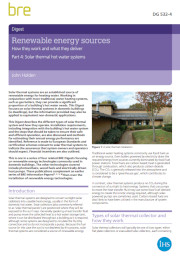
Renewable energy sources: how they work and what they deliver: Part 4: Solar thermal hot water systems (DG 532/4) was written by John Holden and published by BRE on 5 December 2014.
This is one in a series of four BRE Digests focusing on renewable energy technologies commonly used in domestic buildings. They complement an earlier series of BRE Information Papers that cover the installation of renewable energy technologies.
The other technologies covered include:
- Photovoltaics.
- Wood fuels.
- Electrically-driven heat pumps.
Solar thermal systems are designed to convert sunlight (solar radiation) into useable heat energy, usually in the form of domestic hot water. Solar collectors (also commonly referred to as solar thermal panels) are positioned where they will be exposed to the sun’s rays. Generally speaking, a heat transfer fluid and pump move the collected heat to a hot water storage tank, where it can be distributed throughout a building as required, although some systems are designed to circulate the fluid by convection and so do not incorporate a pump. Working together with more traditional water heating systems, such as gas boilers, this can provide a significant proportion of a building’s hot water needs.
DG 532/4 focuses on solar thermal systems in dwellings. The information provided may also be applied to equivalent non-domestic applications. It describes:
- Different types of solar thermal system and how they operate.
- Installation requirements, including integration with hot water systems.
- The steps that should be taken to ensure safe and efficient operation.
- Methods for estimating annual energy performance.
Reference is made to European Standards and certification schemes to indicate the assurances that system owners and operators should expect. Financial incentives are also outlined.
Its contents include:
- Introduction.
- Types of solar thermal collector and how they work.
- Maintenance.
- System design considerations.
- Standards and certification.
- Conclusion.
- References.
[edit] Find out more.
[edit] Related articles on Designing Buildings Wiki
- BRE articles on Designing Buildings Wiki.
- BRE Buzz articles on Designing Buildings Wiki.
- BRE Buzz.
- BRE National Solar Centre.
- BREEAM.
- Large scale solar thermal energy.
- Heat pump.
- Odeillo solar furnace.
- Photovoltaics.
- Renewable energy sources: how they work and what they deliver: Part 3: Electrically driven heat pumps DG 532 3.
- Renewable energy.
- Solar photovoltaics.
- Solar thermal systems
- Solar-assisted heat pump.
- Wind loads on roof-mounted photovoltaic and solar thermal systems DG 489.
Featured articles
Check out some of the best features and news from Designing Buildings as well as key stories from around the web.
Listed structures on the rail network
Heritage interests and operational requirements must be balanced.
Historic England publishes research into embodied carbon when retrofitting traditional buildings.
New Prime Minister delivers on ECA call for cut in electricity costs.

CIOB reacts to the announcement of Andy Burnham as Prime Minister.

Heritage and conservation science workforce survey - Have your say.

England's Suburbs 1820-2020. Book review.

New, more proportionate and targeted approach for higher-risk building assessments.
Government brings British Steel into public ownership.

UKCW Birmingham returns with bold new theme and focus.
New guidance published on competence requirements for self-certification schemes.
Construction Management, 8 July
NEETs crisis drives interest in trades, but apprenticeships barriers remain.
Passive fire protection webinar

MEP services penetration seals.